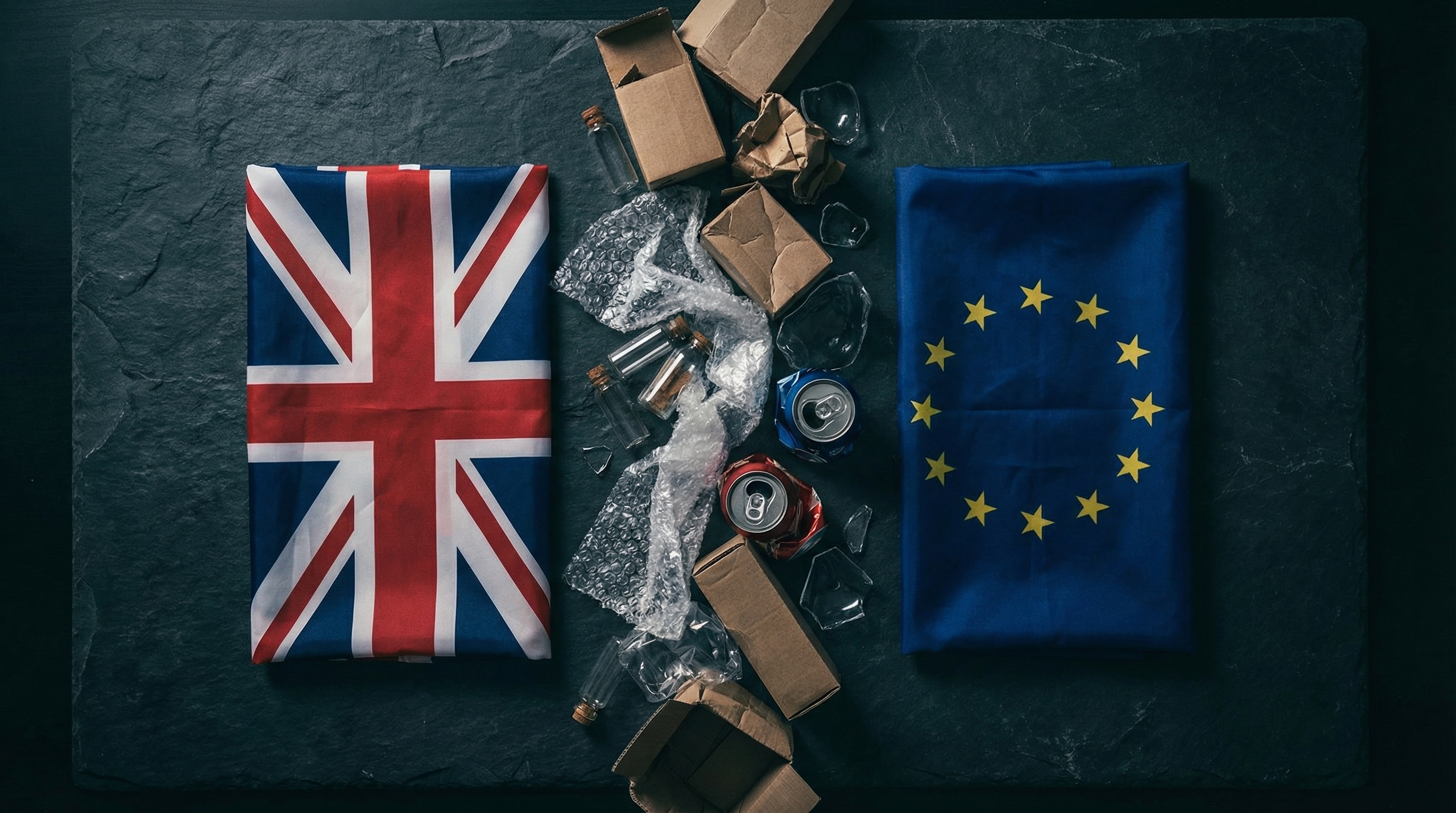
For UK businesses that export into the European Union, the packaging compliance landscape has split into two distinct regulatory regimes. On one side sits the UK's Extended Producer Responsibility (EPR) scheme, reformed and expanded since 2024. On the other sits the EU's Packaging and Packaging Waste Regulation (PPWR), a sweeping new regulation that replaces the 1994 Packaging and Packaging Waste Directive and begins applying in earnest from August 2026.
Before Brexit, UK producers complied with a single set of packaging rules derived from EU directives. That simplicity is gone. The UK and EU have each chosen different approaches to the same fundamental problem: how to reduce packaging waste, increase recycling, and shift the costs of waste management onto the businesses that create the packaging in the first place. The result is two regimes that share a common goal but diverge significantly in their mechanisms, timelines, and specific requirements.
For exporters, this divergence is not an academic concern. If you sell products in both the UK and the EU, you must comply with both systems simultaneously. Getting this wrong carries real consequences: regulatory penalties, market access restrictions, and commercial disadvantage against competitors who have their compliance in order. This guide provides a detailed, side-by-side comparison of the two regimes, highlights where each is stricter, and offers practical guidance for businesses operating across both markets.
What Is the UK EPR?
The UK's Extended Producer Responsibility scheme is the reformed framework for packaging producer obligations in England, Wales, Scotland, and Northern Ireland. It replaced the legacy Packaging Recovery Note (PRN) system with a fundamentally different approach: producers now pay the full net cost of collecting, sorting, and recycling or disposing of the packaging they place on the market.
The UK EPR scheme has been rolling out in phases since 2024. Obligated producers, those handling 50 tonnes or more of packaging and with turnover above £2 million, must register with the Environment Agency, submit detailed packaging data through the DEFRA RPD (Regulated Packaged Data) system, and pay fees that are modulated based on the recyclability and environmental impact of their packaging. The scheme introduced the Recyclability Assessment Methodology (RAM), which assigns each packaging component a recyclability rating that directly affects the fees a producer pays.
The core principle of UK EPR is financial: make producers pay proportionally to the waste burden their packaging creates. Packaging that is easily recycled in practice, not just in theory, attracts lower fees. Packaging that is difficult to recycle, uses problematic materials, or disrupts recycling streams attracts punitive fee adjustments through fee modulation.
What Is the EU PPWR?
The EU Packaging and Packaging Waste Regulation (PPWR) is the European Union's comprehensive overhaul of packaging rules. Adopted in its final form in 2025, the PPWR replaces the 1994 Packaging and Packaging Waste Directive (94/62/EC) with a directly applicable regulation, meaning it applies uniformly across all 27 EU member states without requiring transposition into national law.
The PPWR entered into force on 11 August 2025, with the majority of its substantive provisions applying from 12 August 2026. This is a regulation of extraordinary scope. It introduces mandatory recycled content targets for plastic packaging, binding reuse and refill targets for specific packaging formats, strict packaging minimisation requirements, harmonised labelling rules, substance restrictions including a ban on PFAS in food-contact packaging, and new recyclability criteria that will ultimately determine whether a packaging format may be placed on the EU market at all.
Where the UK EPR is primarily a financial mechanism, using fees to incentivise better packaging design, the EU PPWR is more prescriptive. It tells producers what they must do: how much recycled content they must include, how much void space is acceptable, which substances they cannot use, and which packaging formats must offer reuse options. Non-compliance is not simply a matter of paying higher fees; it can mean a product is prohibited from the EU market entirely.
Regulation vs Directive: Why It Matters
The old EU Packaging Directive was a directive, meaning each member state transposed it into national law, often with variations. The PPWR is a regulation, meaning it applies directly and uniformly across all 27 EU member states. For exporters, this is significant: you no longer need to navigate 27 slightly different national implementations. One set of rules applies everywhere in the EU single market.
Key Differences: Side-by-Side Comparison
The following table sets out the principal differences between the UK EPR and EU PPWR across the areas that matter most for packaging compliance. Understanding these differences is essential for any business that needs to comply with both regimes.
| Aspect | UK EPR | EU PPWR |
|---|---|---|
| Scope and coverage | All packaging placed on the UK market by obligated producers (≥50t packaging, ≥£2m turnover) | All packaging placed on the EU market, regardless of producer size. No de minimis threshold in the regulation itself |
| Recycled content mandates | No mandatory minimums currently. Encouraged through fee modulation and Plastic Packaging Tax (30% threshold) | Mandatory minimums: 30% recycled content in PET contact-sensitive packaging by 2030; 10% in other contact-sensitive plastics by 2030; 35% in single-use plastic bottles by 2030; 65% in all plastic packaging by 2040 |
| Reuse targets | No mandatory reuse targets. Focus is on recyclability | Mandatory reuse targets from 2030: 10% of alcoholic beverages, 10% of non-alcoholic beverages, 10% of transport packaging, rising to 40-90% by 2040 depending on format |
| Recyclability requirements | RAM assessment with 5-stage methodology. Ratings affect fee modulation but do not ban materials outright | EU recyclability criteria with design-for-recycling guidelines. By 2030, packaging must be recyclable. By 2035, packaging must be recycled at scale. Non-compliant formats banned from market |
| Labelling requirements | OPRL (On-Pack Recycling Label) widely used but voluntary. No statutory harmonised label mandated under EPR | Mandatory harmonised labelling from August 2026: material composition, sorting instructions, QR code linking to detailed information. Applies across all 27 member states |
| Fee structure | Modulated fees based on RAM rating. Aggressive adjustments penalise hard-to-recycle packaging. Fees fund collection and recycling infrastructure | EPR fees set at national level by each member state. PPWR requires fee modulation but specifics vary by country. Less aggressive than UK modulation in most member states |
| Compostable packaging | Treated cautiously under RAM. Most compostable packaging rated poorly because it disrupts recycling streams | Mandatory composting for tea bags, coffee pods, fruit stickers, and lightweight plastic bags by 2030. Other compostable packaging restricted |
| Packaging minimisation | No specific void space or minimisation rules. Indirectly encouraged through weight-based fee calculations | Strict minimisation: maximum 50% void space ratio. Minimum packaging weight relative to product. Double walls and false bottoms banned unless functionally necessary |
| Substance restrictions | Heavy metals restricted (legacy regulation). No specific PFAS ban in packaging legislation | PFAS ban in food-contact packaging from 2026. Heavy metals restricted. Bisphenol A restrictions under review. Lead and cadmium limits tightened |
| Digital reporting | DEFRA RPD digital submission. 15-column data format. Annual and half-yearly reporting periods | Digital product passport requirements from 2030. QR codes on packaging linking to recyclability and composition data |
Timeline Comparison
Both regimes are phased in over multiple years, but their timelines differ significantly. Understanding when each requirement bites is critical for compliance planning, particularly for businesses that need to meet both sets of deadlines simultaneously.
UK EPR Phases
| Year | UK EPR Milestone |
|---|---|
| 2024 | Mandatory registration and first data submissions for large producers. PackUK established as scheme administrator |
| 2025 | First fee invoices issued. Fee modulation framework published. RAM assessment becomes central to fee calculations |
| 2026 | Full fee modulation applied. Fees reflect RAM ratings with material-specific adjustments. Second reporting cycle completed |
| 2027 | Deposit Return Scheme launches alongside EPR. Fee adjustments for DRS-eligible containers. Expanded reporting requirements |
| 2028-2029 | Full maturity of fee modulation. Potential RAM methodology updates. Collection reform (Simpler Recycling) fully implemented |
EU PPWR Phases
| Year | EU PPWR Milestone |
|---|---|
| August 2025 | Regulation enters into force. Transitional provisions begin |
| August 2026 | Main provisions apply: labelling requirements, PFAS ban in food-contact packaging, packaging minimisation rules, void space limits |
| 2030 | Recycled content mandates begin (30% for PET contact-sensitive, 10% other contact-sensitive, 35% single-use bottles). Reuse targets begin. All packaging must be recyclable. Mandatory composting for specified formats |
| 2035 | All packaging must be recycled at scale (not just recyclable in theory). Non-compliant formats prohibited. Recycled content targets increase |
| 2040 | 65% recycled content across all plastic packaging. Reuse targets reach maximum levels (up to 90% for transport packaging). Full digital product passport rollout |
Critical Near-Term Date: August 2026
The EU PPWR's main provisions begin applying from 12 August 2026. This is the most immediate deadline for UK exporters. Labelling, packaging minimisation, substance restrictions, and the overall framework all take effect on this date. If you sell into the EU, your packaging must comply from this point forward.
Impact on UK Exporters
For UK businesses that sell products into the EU, the PPWR creates a second, parallel compliance obligation. The practical implications are significant and require careful planning.
Dual compliance obligations
There is no mutual recognition between the UK EPR and the EU PPWR. Complying with one does not satisfy the other. A product sold in both markets must meet UK EPR requirements for the units placed on the UK market and EU PPWR requirements for the units placed on the EU market. This applies to registration, reporting, fee payments, labelling, packaging design, and substance compliance.
Which rules apply where
The territorial principle is straightforward: UK EPR rules apply to packaging placed on the UK market. EU PPWR rules apply to packaging placed on the EU market. If you manufacture products in the UK and export them to the EU, the packaging on those exported units must comply with the PPWR. This is the case regardless of where the packaging was manufactured or designed. It is the market where the product is placed that determines which rules apply.
Products sold in both markets
If you sell the same product in both the UK and the EU, you face a choice: maintain two separate packaging specifications (one for each market) or design a single specification that meets the requirements of both regimes. Maintaining dual specifications increases complexity, inventory management costs, and the risk of shipping the wrong packaging into the wrong market. Designing to a single, higher standard is almost always more cost-effective, though it means your UK packaging may exceed UK requirements in certain areas.
Northern Ireland Protocol complications
The Windsor Framework creates a unique situation for Northern Ireland. Under the framework, Northern Ireland remains aligned with EU single market rules for goods, which means the PPWR applies to packaging placed on the Northern Ireland market. This creates a regulatory boundary within the UK itself. Products moving from Great Britain to Northern Ireland may need to comply with EU PPWR requirements, not just UK EPR rules.
The practical implications are still being worked through by DEFRA and the European Commission, but businesses selling into Northern Ireland should treat it as an EU-aligned jurisdiction for packaging regulation purposes until definitive guidance states otherwise. This is particularly important for labelling, substance restrictions, and recycled content requirements as they come into force.
Where UK EPR Is Stricter Than EU PPWR
The UK has not simply adopted a weaker version of EU rules. In several important areas, the UK EPR regime is more demanding than its EU counterpart.
RAM assessment methodology
The UK's Recyclability Assessment Methodology is one of the most granular recyclability assessment systems in the world. It evaluates packaging across five stages: collectability, sortability, recyclability of the primary material, recyclability of components, and the presence of disruptors. Each stage feeds into an overall rating that directly determines the fee a producer pays.
The EU's recyclability criteria, while increasingly detailed, do not yet operate with the same level of granularity as RAM. The EU approach is more binary: by 2030, packaging must be recyclable; by 2035, it must be recycled at scale. The UK approach creates a spectrum of outcomes, with fee modulation providing a continuous financial incentive to improve, rather than a simple pass/fail threshold.
Fee modulation aggression
The UK's fee modulation system applies significant financial penalties to packaging with poor RAM ratings. The modulation adjustments can increase base fees by substantial multiples for the worst-performing packaging. While the EU PPWR requires member states to implement modulated EPR fees, most member states have adopted less aggressive modulation schedules than the UK. The UK's approach creates a stronger and more immediate financial incentive to improve packaging recyclability.
Specific material penalties
The UK EPR regime takes a particularly tough line on certain materials and packaging features that disrupt recycling streams. Carbon black pigment, for example, renders plastic packaging undetectable by near-infrared sorting equipment and attracts severe fee penalties under RAM. Multi-layer packaging with incompatible polymer layers is another area where the UK assessment is notably harsh. The EU approach to these specific disruptors is generally less punitive, though the 2035 recycled-at-scale requirement will ultimately force similar outcomes.
UK Strictness = Higher Short-Term Costs
The UK's aggressive fee modulation means that producers with hard-to-recycle packaging face higher costs sooner in the UK than they would in most EU member states. However, this creates an opportunity: if you optimise your packaging for UK EPR, you are likely already exceeding EU recyclability requirements for 2026 and positioning well for the 2030 and 2035 EU deadlines.
Where EU PPWR Is Stricter Than UK EPR
In several critical areas, the EU PPWR goes significantly further than the UK EPR. These are the areas where UK exporters need to pay closest attention, because meeting UK EPR requirements alone will not be sufficient for EU market access.
Recycled content mandates
This is perhaps the single biggest difference between the two regimes. The EU PPWR introduces binding, mandatory minimum recycled content targets for plastic packaging. By 2030, contact-sensitive PET packaging (food and drink bottles) must contain at least 30% recycled content. Other contact-sensitive plastic packaging must contain at least 10%. Single-use plastic beverage bottles must reach 35%. By 2040, all plastic packaging must contain at least 65% recycled content.
The UK has no equivalent mandate. The Plastic Packaging Tax provides a financial incentive to include at least 30% recycled content in plastic packaging, but it is a tax mechanism, not a mandatory minimum. You can still place packaging with zero recycled content on the UK market; you simply pay the tax. Under the PPWR, failing to meet the mandated minimums means your packaging cannot legally be placed on the EU market.
Mandatory reuse quotas
The EU PPWR introduces mandatory reuse and refill targets that have no UK equivalent. From 2030, producers must offer a percentage of their packaging in reusable formats. The targets vary by sector: 10% for alcoholic and non-alcoholic beverages, 10% for transport packaging, with these figures rising dramatically by 2040 (up to 25% for beverages, 40% for transport packaging to the final distributor, and 90% for pallets). While certain exemptions exist for small producers and specific packaging types, the direction of travel is clear: the EU expects a fundamental shift towards reuse systems.
The UK EPR scheme has no mandatory reuse targets. The UK approach focuses almost entirely on improving the recyclability of single-use packaging rather than shifting to reuse models. This is a fundamental philosophical difference between the two regimes, and it creates significant compliance challenges for exporters who may need to develop reusable packaging options for their EU business while continuing to use single-use formats in the UK.
Packaging minimisation
The PPWR introduces some of the most prescriptive packaging minimisation rules anywhere in the world. The headline requirement is a maximum 50% void space ratio: the empty space within a sales package must not exceed 50% of the total package volume. Beyond this, the regulation prohibits double walls, false bottoms, and unnecessarily thick materials unless they are functionally necessary. Packaging weight must be minimised relative to the product being contained, and producers must demonstrate that their packaging cannot be further reduced without compromising product protection, safety, or hygiene.
The UK EPR has no equivalent minimisation rules. UK fees are calculated partly on the basis of weight, which provides some indirect incentive to reduce packaging mass, but there are no void space limits, no prohibition on double walls, and no requirement to demonstrate that packaging has been minimised. For exporters, this means EU-bound products must meet minimisation criteria that may not be relevant for the same products sold domestically in the UK.
Substance restrictions: the PFAS ban
The EU PPWR includes a ban on per- and polyfluoroalkyl substances (PFAS) in food-contact packaging, effective from 2026. PFAS are widely used in grease-resistant food packaging, including fast-food wrappers, pizza boxes, microwave popcorn bags, and other food-contact applications. The ban reflects growing concern about the environmental persistence and health risks associated with these "forever chemicals."
The UK has not legislated an equivalent PFAS ban in packaging. While the UK's chemicals regulation framework (UK REACH) is considering broader PFAS restrictions, there is no specific prohibition on PFAS in packaging under the EPR scheme. UK exporters who use PFAS-containing packaging for food products sold in the EU will need to reformulate or switch to alternative materials to comply with the PPWR ban.
Navigate dual compliance with confidence
Repackd helps you track your UK EPR obligations, assess RAM ratings, model fee modulation, and identify where your packaging may need changes for EU PPWR compliance. One platform for your entire packaging compliance workflow.
Practical Guidance for Dual-Market Businesses
Managing compliance across both the UK EPR and EU PPWR is complex, but a structured approach makes it manageable. Here are the strategies that work best for businesses operating in both markets.
Design for the stricter standard
The most cost-effective approach for most businesses is to design packaging that meets the stricter requirement across both regimes. Rather than maintaining two separate packaging specifications, design one that satisfies both. In practice, this typically means meeting EU PPWR standards for recycled content, minimisation, and substance restrictions, while also optimising your RAM rating to minimise UK fee modulation penalties.
This approach eliminates the risk of shipping non-compliant packaging into the wrong market, reduces inventory complexity, and simplifies procurement. The marginal cost of meeting the stricter standard on your UK packaging is almost always lower than the cost of running parallel packaging operations.
Packaging rationalisation strategies
The twin pressures of UK EPR fee modulation and EU PPWR mandates create a strong business case for packaging rationalisation. This means reviewing your entire packaging portfolio to identify opportunities to standardise formats, consolidate material types, and eliminate packaging that performs poorly under either regime.
Start with the packaging that is most problematic: formats that score poorly on RAM and face challenges under PPWR. Multi-layer flexible packaging, dark-pigmented plastics, and formats with excessive void space are prime candidates for redesign. Moving these to mono-material, lighter, right-sized alternatives addresses both regimes simultaneously.
Consider conducting a full packaging compliance audit that maps each SKU against both UK EPR and EU PPWR requirements. This exercise identifies the gaps, prioritises the changes, and quantifies the cost of compliance versus the cost of non-compliance for each packaging format.
Compliance tracking across jurisdictions
Dual compliance requires robust data management. You need to track which units are placed on which market, what the regulatory requirements are for each market, and whether your packaging meets those requirements. This is not something that can be managed effectively in spreadsheets once you are dealing with multiple SKUs, multiple markets, and two sets of evolving regulations.
A dedicated compliance platform that tracks both your UK EPR data (packaging weights, material types, RAM ratings, fee calculations) and your EU PPWR obligations (recycled content percentages, void space ratios, substance compliance) in a single system is the most reliable approach. It ensures nothing falls through the gaps when requirements change, and it provides an audit trail that demonstrates compliance to regulators in both jurisdictions.
Future Convergence or Divergence?
One of the most common questions from dual-market businesses is whether the UK and EU regimes will converge over time, reducing the compliance burden, or continue to diverge, increasing it.
The honest answer is that divergence is more likely than convergence in the medium term. The UK and EU have made fundamentally different design choices. The UK has built its system around financial incentives (fee modulation based on RAM ratings), while the EU has opted for prescriptive mandates (mandatory recycled content, mandatory reuse targets, substance bans). These are structurally different approaches, and neither side has shown any inclination to adopt the other's model.
There are areas where the direction of travel is similar. Both regimes want packaging to be recyclable in practice, both are moving towards greater transparency and data reporting, and both are increasing the financial burden on producers of hard-to-recycle packaging. But the mechanisms by which they pursue these goals are diverging, not converging. The UK is unlikely to adopt mandatory recycled content targets in the near term, and the EU is unlikely to adopt a RAM-style granular assessment system.
For businesses, this means planning for sustained dual compliance. Do not assume that the regimes will align and reduce your burden. Instead, build compliance processes that can handle two parallel sets of requirements indefinitely, with the flexibility to adapt as each regime evolves independently.
The Strategic Opportunity in Divergence
While dual compliance is a burden, it is also a competitive differentiator. Businesses that build robust dual-compliance capabilities now will be better positioned than competitors who treat EU and UK requirements as afterthoughts. Packaging that meets both UK EPR and EU PPWR standards will also be well-positioned for markets outside Europe that are developing their own packaging regulations, many of which are drawing on either the UK or EU model.
Labelling: A Practical Comparison
Labelling is one of the areas where the UK and EU approaches diverge most visibly, and where dual-market businesses face the most immediate practical challenge.
In the UK, the OPRL (On-Pack Recycling Label) system is widely used but remains voluntary. The familiar "Widely Recycled," "Check Locally," and "Not Yet Recycled" labels are a recognised standard, but there is no statutory requirement under EPR to use them. The UK government has indicated that mandatory labelling may be introduced in future, but as of 2026, it remains guidance rather than law.
The EU PPWR, by contrast, mandates harmonised labelling from August 2026. All packaging placed on the EU market must carry labels indicating material composition and waste sorting instructions, in a standardised format that is consistent across all 27 member states. From 2030, packaging must also carry a QR code or digital identifier linking to more detailed information about composition, recyclability, and proper disposal.
For dual-market businesses, this means that EU-bound packaging must carry the mandatory PPWR labelling from August 2026, while UK packaging does not yet require statutory labels. If you design a single packaging specification for both markets, the EU labelling requirements set the floor. You can add OPRL labels for the UK market alongside the PPWR-mandated labels if you wish, or simply use the PPWR labels, which provide equivalent information in a format that satisfies the EU requirement.
Substance Compliance: What to Watch
Beyond PFAS, the EU PPWR introduces or tightens several substance restrictions that UK producers need to be aware of. Heavy metal limits (lead, cadmium, mercury, and hexavalent chromium) are tightened, with a combined limit of 100 ppm. Bisphenol A (BPA) in food-contact packaging is under active review, with restrictions expected. Intentionally added microplastics in packaging coatings face restrictions under the broader EU chemicals framework.
The UK's substance restrictions for packaging remain rooted in the legacy heavy metals limits transposed from older EU directives. The UK REACH framework is evolving, but it has not yet matched the pace of EU action on packaging-specific substance restrictions. UK exporters should monitor both UK REACH developments and EU PPWR substance provisions, as compliance with one does not guarantee compliance with the other.
How Repackd Helps
Repackd is built for UK EPR compliance: RAM assessments, fee modulation calculations, DEFRA RPD data management, and compliance reporting. For businesses that also export to the EU, the same packaging data you manage in Repackd for UK EPR, material types, weights, components, recyclability assessments, forms the foundation for understanding your EU PPWR exposure.
By getting your UK EPR compliance right with Repackd, you establish the data infrastructure and packaging intelligence needed to assess and plan for EU PPWR requirements. You know exactly what materials you use, how recyclable your packaging is, which formats are under-performing, and where the opportunities for improvement lie. That knowledge transfers directly to PPWR compliance planning.
If you are a UK producer or exporter navigating dual compliance obligations, explore what Repackd offers and see how a systematic, data-driven approach to packaging compliance can reduce your risk and simplify your operations across both markets.
Get your UK EPR compliance sorted
Start with Repackd to manage your UK EPR data, RAM assessments, and fee modulation. Build the packaging intelligence foundation you need for dual UK-EU compliance.