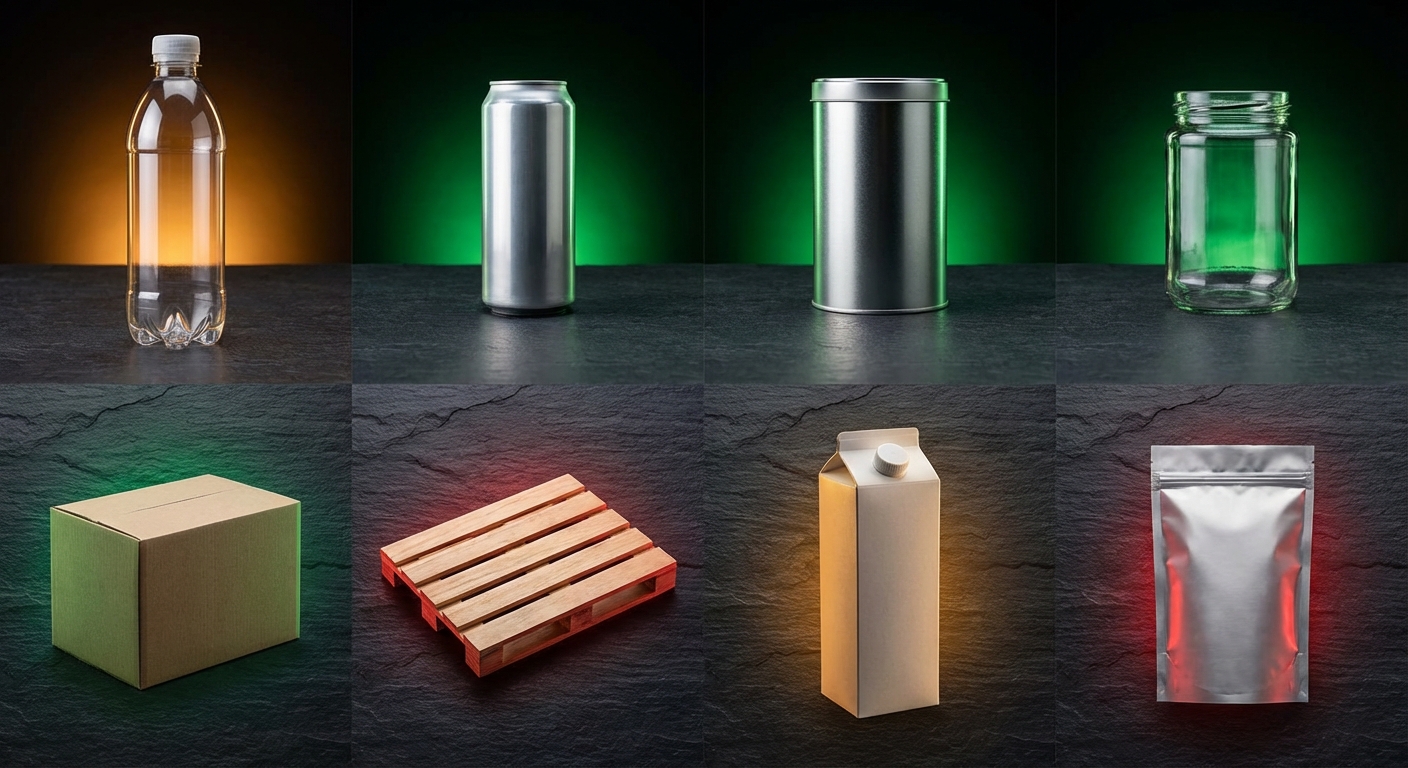
The Recyclability Assessment Methodology — RAM — is the framework that determines how recyclable your packaging is under the UK EPR scheme. Every household packaging component receives a rating of , , or based on how it performs across five assessment stages: Classification, Collection, Sortation, Reprocessing, and End Market Application.
But here is the thing most producers get wrong: the material alone does not determine the rating. Two packaging items made from exactly the same polymer can receive different ratings depending on format, colour, labels, closures, and component structure. A clear PET bottle is typically Green. A black PET tray using carbon black pigment is Red. Same polymer, different rating, vastly different fee implications.
This guide provides a material-by-material breakdown of typical RAM ratings, the factors that push ratings up or down, and practical steps to improve recyclability for each material type. We cover all eight material categories recognised by the DEFRA RPD system. For a deeper understanding of the RAM methodology itself, see our RAM Explained page.
Quick Reference: RAM Ratings by Material
Before we dive into the detail, here is a summary table showing the typical RAM ratings for common packaging formats within each material type.
| Material | Common Format | Typical Rating | Key Factor |
|---|---|---|---|
| PET | Clear bottle | Widely collected, sorted, reprocessed | |
| PET | Black tray (carbon black) | NIR-invisible, fails sortation | |
| HDPE | Natural/white bottle | Strong collection and reprocessing | |
| PP | Pot, tub, tray | Collection improving, reprocessing limited | |
| PS | Any format | Very limited reprocessing infrastructure | |
| PVC | Any format | Contaminant in recycling streams | |
| Paper/Card | Corrugated cardboard | Established collection and reprocessing | |
| Paper/Card | Wax-coated card | Wax contaminates pulping process | |
| Glass | Bottle or jar | Infinitely recyclable, strong infrastructure | |
| Aluminium | Can | High value, strong recovery rates | |
| Steel | Can or tin | Magnetic separation, strong reprocessing | |
| Wood | Pallet / crate | Reuse common, recycling variable | |
| Fibre Composite | Beverage carton | Specialist reprocessing required | |
| Multi-layer flexible | Pouch, sachet | Cannot be separated for recycling |
Now let us examine each material in detail.
Plastic: The Most Variable Material
Plastic is the material category where RAM ratings vary the most. The rating depends heavily on the specific polymer, the format, the colour, and any additional components. There is no single “RAM rating for plastic” — it ranges from Green to Red depending on what you are dealing with.
PET (Polyethylene Terephthalate)
PET is one of the most widely recycled plastics with established collection, sortation, and reprocessing infrastructure across the UK. Clear and light-coloured PET bottles are the gold standard for plastic recyclability and typically receive a rating.
However, PET ratings degrade quickly when you move away from the standard bottle format:
- Clear PET bottles: — Widely collected, easily sorted by NIR, strong end markets for rPET
- Coloured PET bottles (light colours): to — Sortable but colour reduces end market value
- PET trays (clear): — Collection improving but tray recycling infrastructure is less developed than bottles
- PET trays (black, carbon black): — Invisible to NIR sorting equipment
- PET with full-body shrink sleeve: to — Sleeve obscures the bottle from NIR detection and contaminates the PET stream if made from a different polymer
How to improve PET ratings: Use clear or light colours. Avoid carbon black pigment entirely — switch to detectable dark pigment alternatives. Minimise label coverage area. Use labels made from the same polymer family (PET labels on PET bottles). Avoid full-body sleeves.
HDPE (High-Density Polyethylene)
HDPE bottles, particularly natural (translucent) and white bottles, have strong recycling infrastructure and typically achieve ratings. HDPE is widely used for milk bottles, household cleaning products, and personal care packaging.
- Natural/white HDPE bottles: — Excellent collection, sortation, and reprocessing
- Coloured HDPE bottles: to — Colour reduces recyclate value but still sortable
- HDPE pots and tubs: — Format less well-supported than bottles in current infrastructure
- Black HDPE (carbon black): — NIR invisible
How to improve HDPE ratings: Stick to natural or white colours. Avoid carbon black. Use compatible closures. Consider whether a bottle format can replace a tub or pot format.
PP (Polypropylene)
PP is increasingly collected in kerbside recycling across the UK, but the sortation and reprocessing infrastructure is less mature than for PET and HDPE. PP packaging typically receives ratings, though this is improving as collection rates increase.
- PP pots, tubs, trays: — Collection expanding, reprocessing capacity growing
- PP bottles: to — Better sortation performance in bottle format
- Black PP (carbon black): — NIR invisible
- PP film: — Flexible film not collected in most kerbside schemes
How to improve PP ratings: Use light colours. Avoid carbon black. Monitor the rollout of consistent collection schemes, which is expected to improve PP collection rates and potentially upgrade ratings in future RAM revisions.
PS (Polystyrene)
Polystyrene, both expanded (EPS) and solid, has very limited recycling infrastructure in the UK. Most PS packaging receives a rating because it fails at the reprocessing and end market stages.
- EPS (expanded polystyrene): — Not collected in most kerbside schemes, very low density makes transport uneconomic
- Solid PS (yoghurt pots, etc.): — Limited reprocessing capacity
How to improve: The most effective strategy is material substitution. Replace PS with PP or PET where functionally possible. There is no realistic path to a Green rating for PS packaging under the current RAM framework.
PVC (Polyvinyl Chloride)
PVC is considered a contaminant in most plastic recycling streams and receives a consistent rating across all formats. The chlorine content in PVC creates processing problems and can damage equipment.
How to improve: Substitute PVC entirely. Most PVC packaging applications have viable alternatives in PET, PP, or HDPE. Blister packs traditionally made from PVC can often be switched to PET or rPET.
Carbon Black: The Silent Rating Killer
Carbon black pigment appears repeatedly across all plastic types because it is the single most common cause of avoidable Red ratings. Any plastic packaging coloured with carbon black fails RAM Stage 3 (Sortation) because it absorbs near-infrared light, making it invisible to the automated sorting equipment used by UK MRFs. Detectable alternatives exist for every application and are now competitively priced. If you use any dark-coloured plastic packaging, check with your supplier immediately whether it contains carbon black. For more detail, see our guide to carbon black alternatives.
Know your RAM ratings instantly
Repackd assesses every packaging component against all 5 RAM stages and 18 DEFRA material profiles. Get audit-ready ratings with full documentation in seconds.
Paper and Card
Paper and card packaging generally performs well under RAM, with corrugated cardboard and standard card achieving ratings. The UK has well-established paper recycling infrastructure with strong end markets for recovered fibre. However, contamination issues can push ratings down significantly.
- Corrugated cardboard: — The most widely recycled packaging material in the UK
- Standard card (folding boxboard): — Good collection and reprocessing
- Paper (wrapping, tissue, etc.): — Provided it is uncoated or has a recyclable coating
- Card with plastic lamination: to — Plastic film must be separated from the fibre, which many reprocessors cannot do
- Wax-coated card: — Wax contaminates the pulping process and is rejected by most reprocessors
- Metalised card: — Metallic coatings contaminate the fibre stream
- Wet-strength paper: to — Chemical treatments that give paper wet strength also make it difficult to repulp
How to improve paper/card ratings: Avoid plastic lamination where possible — use water-based barrier coatings instead. Eliminate wax coatings. Use vegetable-based inks. Avoid metallic finishes. If a protective coating is needed, choose options specifically designed to be compatible with paper recycling (repulpable coatings are increasingly available).
Glass
Glass is one of the strongest performers under RAM. It is infinitely recyclable, collected in almost all UK kerbside schemes, and has strong domestic reprocessing capacity. Standard glass bottles and jars consistently receive ratings.
- Clear glass bottles and jars: — Excellent across all RAM stages
- Green glass: — Well-established colour stream in glass recycling
- Amber/brown glass: — Strong collection and reprocessing
- Blue or other coloured glass: — Non-standard colours can contaminate colour-sorted streams
- Pyrex/borosilicate glass: — Different melting point, contaminates soda-lime glass recycling
- Ceramic closures on glass: No impact on the glass body rating, but the closure is assessed separately
How to improve glass ratings: Stick to clear, green, or amber glass. Avoid non-standard colours. Ensure closures and labels are compatible with glass recycling (easily separable). Glass is already one of the best materials for RAM performance — the main risk is non-standard formulations or colours.
Aluminium
Aluminium packaging benefits from its high material value, which drives strong collection and recycling rates. Aluminium cans consistently achieve ratings. The material is infinitely recyclable and requires only 5% of the energy to recycle compared to producing virgin aluminium.
- Aluminium cans (beverage): — Among the highest recycling rates of any packaging material
- Aluminium food trays: — Good collection and reprocessing, though slightly lower than cans
- Aluminium foil: — Lightweight foil can be lost during sortation and contaminated with food residue
- Aluminium aerosols: — Increasingly collected, though some local authorities still exclude them
- Aluminium closures and caps: — Separated and recovered during metal recycling
How to improve aluminium ratings: Aluminium is already strong. For foil applications, consider increasing gauge (thicker foil is less likely to be lost in sortation) or switching to a tray format. Ensure aerosol containers are clearly labelled as recyclable.
Steel
Steel packaging benefits from magnetic sortation — it can be extracted from mixed waste streams using magnets, which makes collection and sortation highly efficient. Steel cans and tins consistently receive ratings.
- Steel cans and tins: — Magnetic separation makes sortation simple and effective
- Steel aerosols: — Increasingly accepted in kerbside collection
- Steel closures and crown caps: — Recovered through magnetic separation
- Tinplate with non-removable plastic components: — Non-separable plastic can contaminate the steel recycling process
How to improve steel ratings: Steel is already excellent. Avoid non-separable plastic components (such as non-removable plastic handles or spray mechanisms that cannot be easily separated from the steel body).
Wood
Wood packaging is primarily used in transit and industrial applications (pallets, crates, boxes). Its RAM performance depends on whether it is in a reuse system and how contaminated it is at end of life.
- Wood pallets (reusable, pooled): to — Reuse systems have good environmental outcomes, but end-of-life recycling varies
- Wood crates and boxes: — Can be recycled into chipboard or biomass, but collection varies
- Treated or painted wood: — Chemical treatments can contaminate recycling streams
- Small wood packaging (wine box frames, etc.): to — Small items often not collected separately
How to improve wood ratings: Use untreated wood where possible. Participate in pallet pooling or reuse schemes. Avoid chemical treatments, paint, and staples or nails that are difficult to separate.
Fibre Composite
Fibre composite packaging — most commonly beverage cartons (like Tetra Pak) — is made from multiple layers of paperboard, polyethylene, and sometimes aluminium foil. This multi-material construction creates recycling challenges because the layers must be separated before each material can be reprocessed.
- Beverage cartons (Tetra Pak style): — Specialist reprocessing exists in the UK but capacity is limited
- Fibre composite tubes (Pringles-style): — Metal base, plastic cap, and composite tube are very difficult to recycle as a unit
- Fibre composite cups (disposable coffee cups): — PE-lined paper cups require specialist facilities
How to improve fibre composite ratings: This is one of the hardest material categories to improve. Where possible, consider switching to mono-material alternatives (all-paper, all-plastic, or glass). For beverage cartons, the industry is investing in reprocessing capacity, and ratings may improve as infrastructure develops. For composite tubes and cups, material substitution is the most practical route to better ratings.
Other Materials
The “Other” category in the DEFRA classification catches materials that do not fit into the main categories. This includes biodegradable and compostable plastics, rubber, textiles used as packaging, and novel materials.
- Compostable plastics (PLA, etc.): — Contaminates conventional plastic recycling streams and most UK composting facilities do not accept them
- Biodegradable plastics: — Same contamination issues as compostable plastics
- Natural fibre packaging (hemp, jute, etc.): to — Limited collection and reprocessing infrastructure
Compostable Packaging Is Not Recyclable
A common misconception is that compostable or biodegradable packaging will receive a favourable RAM rating because it is “eco-friendly.” Under RAM, the assessment is based on whether the material can be recycled through the existing UK waste infrastructure. Compostable plastics cannot be recycled in conventional plastic recycling and are typically not accepted by industrial composting facilities either. They contaminate PET and other recycling streams. Until dedicated collection and processing infrastructure exists at scale, compostable packaging will continue to receive Red ratings.
The Impact on Your Fees
RAM ratings translate directly into fee costs through the modulation framework. Here is how the ratings affect your bottom line across the modulation timeline.
| Rating | 2025-26 (1.0x) | 2026-27 (1.2x) | 2027-28 (1.6x) | 2028-29 (2.0x) |
|---|---|---|---|---|
| £200/T | £200/T | £200/T | £200/T | |
| £200/T | £220/T | £260/T | £300/T | |
| £200/T | £240/T | £320/T | £400/T |
Illustrative figures based on a £200/tonne base rate. Actual rates vary by material type.
The financial incentive is clear: every component you can move from Red to Green saves up to £200 per tonne by Year 4 of the modulation schedule. For a producer handling 50 tonnes of household packaging, that is potentially £10,000 per year in fee savings — and those savings recur every year. For a comprehensive look at the fee implications, see our EPR fees explained page. Your RAM ratings also drive the OPRL classification displayed on your packaging, which becomes a legal requirement when mandatory recyclability labelling takes effect in April 2027.
Material Substitution: A Decision Framework
When a packaging component has a poor RAM rating, the most impactful change is often material substitution — switching from a poorly rated material to a well-rated one. But material decisions involve trade-offs beyond recyclability: cost, performance, shelf life, consumer perception, and supply chain implications.
Here is a framework for evaluating material substitution opportunities:
- Identify Red-rated components: Start with your highest-tonnage Red-rated items. These have the biggest fee impact and the greatest potential for savings.
- Check for simple fixes first: Before changing the base material, check whether a colour change (removing carbon black), label change (switching to a compatible label material), or closure change can improve the rating. These are often cheaper and faster than a full material switch.
- Evaluate alternatives: For each component, identify which alternative materials could deliver the same functional performance. Consider: PET to replace PVC for blister packs, PP to replace PS for pots and tubs, paper to replace plastic for wrapping, aluminium to replace mixed-material laminates for barrier applications.
- Calculate the fee impact: Model the fee difference between the current and proposed materials over the modulation timeline. A switch that saves £2 per tonne in Year 2 saves £10 per tonne by Year 4.
- Factor in transition costs: New tooling, new supplier relationships, potential pack format changes, and consumer communication all carry costs. Compare the total transition cost against the cumulative fee savings over 3-5 years.
For more detailed guidance on improving your RAM ratings through material and design changes, see our guide on how to improve your packaging RAM rating.
Assess every material, every component
Repackd runs automated RAM assessments across all 5 stages and 18 DEFRA material profiles. Identify Red-rated components, model fee savings from material changes, and export audit-ready documentation.