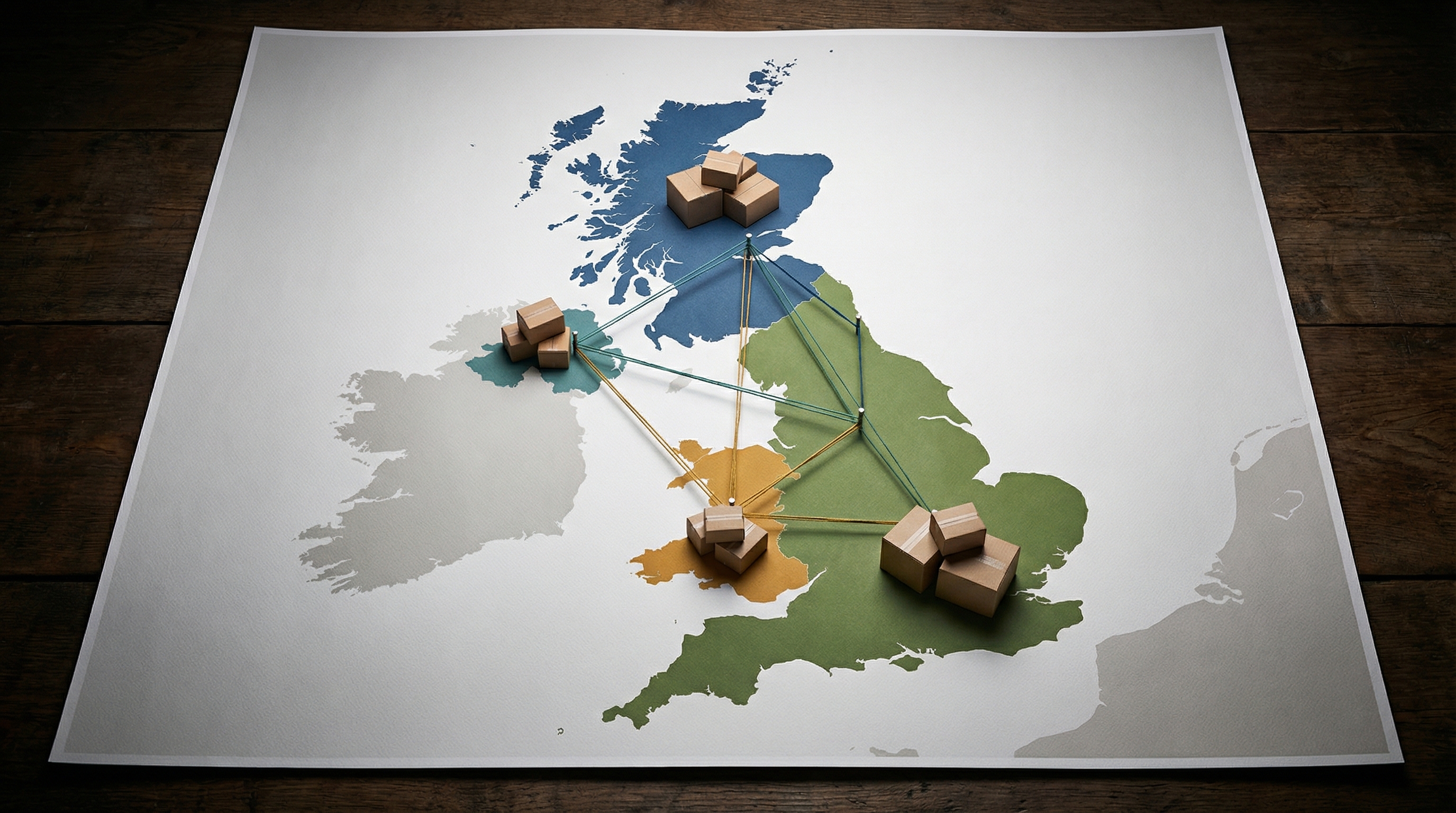
If you are an obligated producer under the UK's Extended Producer Responsibility (EPR) scheme, there is a significant new reporting requirement you need to prepare for: nation of sale data. From the 2026 reporting year, producers must report not just what packaging they place on the market and how much of it, but which UK nation that packaging is sold in — England, Scotland, Wales, or Northern Ireland.
This is not a minor administrative tweak. It introduces an entirely new dimension to your packaging data collection, requiring you to track and allocate sales across the four UK nations. For some businesses, this will be straightforward. For others, particularly those selling through wholesalers, distributors, or UK-wide retail chains, it represents a genuine data challenge that needs planning and preparation.
This guide explains what nation of sale data is, why it matters, who needs to report it, and the practical approaches you can take to collect and report it accurately. We also cover the common challenges producers face and how to handle situations where exact nation-level data simply is not available.
What Is Nation of Sale Data?
Nation of sale data is the requirement to break down your packaging data submission by the UK nation where the packaging is ultimately sold to the end consumer. Instead of reporting a single UK-wide tonnage figure for each packaging material and category, you must allocate that tonnage across four nations: England, Scotland, Wales, and Northern Ireland.
This applies to all packaging types reported under EPR — primary, secondary, shipment, and transit packaging. For each line of your DEFRA RPD submission, you will need to indicate the nation where that packaging was sold. The data fields themselves are not complex; it is the collection and allocation of the underlying sales data that creates the challenge.
Key Definition
Nation of sale refers to the UK nation where the packed product is sold to the final consumer. It is not the nation where the product is manufactured, warehoused, or distributed from. A product manufactured in England but sold in a Scottish supermarket counts as a Scottish sale. The focus is always on the point of final sale to the end user.
The concept is simple in principle: if you sell 100 tonnes of cardboard packaging and 70 tonnes goes to England, 15 tonnes to Scotland, 10 tonnes to Wales, and 5 tonnes to Northern Ireland, you report those four separate figures rather than a single 100-tonne UK total. The complexity arises in determining those splits accurately, particularly when you do not sell directly to end consumers and have limited visibility of where products ultimately end up.
Why Is Nation of Sale Data Required?
The requirement for nation of sale data is driven by the devolved nature of waste management and environmental regulation in the UK. While EPR is a UK-wide scheme, waste collection and disposal infrastructure is managed at the national level. Each of the four UK nations funds and operates its own local authority collection systems, and the EPR fee revenue that producers pay is intended to cover the costs of collecting and processing their packaging waste.
For this funding mechanism to work fairly, DEFRA and the devolved governments need to know how much packaging waste is generated in each nation. If a producer sells 90% of their products in England and 10% in Scotland, the EPR fees they pay should be distributed accordingly: 90% to fund English collection infrastructure and 10% to fund Scottish collection infrastructure. Without nation of sale data, there is no basis for this allocation.
The Devolved Funding Logic
EPR fees are not collected into a single UK-wide pot. They are allocated to the nation where the packaging waste arises. Nation of sale data is the mechanism that enables this allocation. Without it, the devolved governments cannot receive their fair share of producer funding, and local authorities cannot be properly compensated for the packaging waste they collect.
Prior to this requirement, EPR reporting was effectively UK-wide, with no nation-level granularity. This was always a simplification that would need to be addressed as EPR matured. With the reformed EPR scheme now operational and significant fee revenue flowing from producers to fund collection infrastructure, accurate nation-level allocation has become essential. The EPR fees for 2026-2027 are substantial, and the devolved nations rightly expect the revenue to reflect where packaging waste actually arises.
Who Needs to Report Nation of Sale Data?
All obligated producers must report nation of sale data. This includes both large producers (turnover above £2 million and handling more than 50 tonnes of packaging) and small producers (turnover above £1 million and handling more than 25 tonnes of packaging, but below the large producer thresholds).
There is no exemption from nation of sale reporting based on producer size. If you are obligated under EPR, you must provide nation-level data. The logic is straightforward: every producer's packaging ends up somewhere, and that somewhere needs to be attributed to a nation for the funding allocation to work.
The requirement also applies regardless of how you sell your products. Whether you sell direct to consumers, through retailers, through wholesalers, or through a combination of channels, you must report nation of sale data. The challenge varies significantly by channel — as we will explore below — but the obligation is universal.
The Deadline
Nation of sale data must be collected from the 2026 reporting year (1 January to 31 December 2026) and submitted as part of your packaging data return in April 2027. This means producers need to have their data collection systems and processes in place from the start of 2026.
Timeline Summary
Data collection period: 1 January 2026 – 31 December 2026
Submission deadline: April 2027 (exact date to be confirmed by DEFRA)
Action required now: Ensure your sales data systems can capture or estimate nation of sale from the start of the 2026 reporting year.
If you have not already started preparing for this, you are behind. The reporting year is already underway, which means every sale you make from January 2026 onwards should ideally be tagged with nation of sale information, or you should have an allocation methodology in place that you can apply retrospectively to your sales data. Check the full DEFRA deadlines for 2026 to ensure this fits within your broader compliance calendar.
What Fields Are Needed?
The nation of sale data requirement adds a nation allocation to each line of your packaging data return. For each combination of packaging material, packaging type, and activity (manufacturing, importing, selling), you must provide the tonnage split across the four nations.
| Nation | Allocation Field | Population Share (approx.) |
|---|---|---|
| England | Tonnage sold in England | 84% |
| Scotland | Tonnage sold in Scotland | 8% |
| Wales | Tonnage sold in Wales | 5% |
| Northern Ireland | Tonnage sold in Northern Ireland | 3% |
The sum of your four nation allocations for each packaging line must equal the total UK tonnage for that line. You cannot report a UK total and leave the nation split blank, nor can you allocate more or less than the total. The four nation figures must reconcile precisely to the overall figure.
In practical terms, this means your data collection system needs to be capable of either recording the nation at the point of sale, or applying an allocation methodology after the fact. Either approach is acceptable, provided the resulting data is defensible and as accurate as your available information allows. The Repackd glossary covers all the key terms if you need to clarify any definitions.
How to Collect Nation of Sale Data
The approach you take to collecting nation of sale data depends heavily on your sales channels. There is no single method that works for every producer; the right approach is determined by how you sell, to whom you sell, and what data you already have access to.
Direct-to-consumer sales (including e-commerce)
If you sell directly to end consumers, nation of sale data is relatively straightforward to collect. Every sale has a delivery address or a point-of-sale location, and that address tells you the nation. For e-commerce and mail order sales, the delivery postcode gives you a precise nation allocation. For physical retail where you operate your own stores, the store location determines the nation.
The key is to ensure your order management or point-of-sale system can extract nation-level data from transaction records. Most modern e-commerce platforms can do this natively or with minimal configuration. You need to be able to run a report that shows total sales by nation for the reporting period, which you can then use to allocate your packaging tonnage.
For direct-to-consumer sellers, the practical steps are:
- Ensure your order management system captures the delivery postcode for every transaction.
- Map postcodes to nations (England, Scotland, Wales, Northern Ireland). Standard postcode-to-nation lookup tables are freely available.
- Run nation-level sales reports at the end of each reporting period.
- Allocate your packaging tonnage in proportion to the nation-level sales volumes.
Sales through retailers
If you sell products through retail chains, the picture becomes more complex but is still manageable. Large retailers, particularly supermarkets and national chains, typically have EPOS (electronic point of sale) data that records sales at the store level. Since each store has a known location, this data can be aggregated to the nation level.
The challenge is accessing this data. Retailers may provide suppliers with sales data broken down by store, region, or nation, but the level of detail varies. Some retailers share granular EPOS data with suppliers through dedicated data portals; others provide only aggregate UK-wide figures. You may need to request nation-level sales breakdowns specifically, and your buyer or account manager is the right starting point for this conversation.
Where retailers cannot or will not provide nation-level EPOS data, you can use the retailer's store distribution as a proxy. If a retailer has 800 stores in England, 80 in Scotland, 50 in Wales, and 20 in Northern Ireland, you can allocate your sales to that retailer proportionally across nations based on store count. This is not perfect — stores in different nations may have different sales volumes — but it is a reasonable and defensible approach where better data is not available.
Sales through wholesalers and distributors
This is where nation of sale data becomes genuinely difficult. When you sell products to a wholesaler or distributor, you typically know where the wholesaler's warehouse is, but not where the products ultimately end up. A wholesaler based in Birmingham may supply retailers, caterers, and independent shops across the entire UK. Your sale to the wholesaler happens in England, but the final sale to the end consumer could be in any nation.
For wholesale channels, the options are:
- Request nation-level data from your wholesaler. Some wholesalers can provide a breakdown of where they distribute your products. This is the best option where available, but many wholesalers do not track or share this data.
- Use the wholesaler's delivery footprint. If the wholesaler primarily serves a specific region or nation, you can allocate based on their known distribution area.
- Fall back to population-based estimation. Where no nation-level distribution data is available from the wholesaler, the default approach is to allocate based on UK population shares. We cover this methodology in detail below.
Marketplace sellers
Producers who sell through online marketplaces (such as Amazon, eBay, or sector-specific platforms) face a mixed situation. Marketplace platforms vary in the level of sales data they share with sellers. Some provide detailed order-level data including delivery addresses; others provide only aggregate sales figures.
If the marketplace provides delivery address or postcode data, use it to allocate by nation in the same way as direct e-commerce sales. If only aggregate data is available, you may need to request a nation-level breakdown from the marketplace, or fall back to population-based estimation. As marketplace sales become a larger proportion of total retail, platforms are increasingly able to provide this level of granularity, so it is worth asking even if you have not received it before.
Population-Based Estimation: The Default Methodology
DEFRA recognises that not all producers will have exact nation-of-sale data for every unit of packaging they place on the market. Where producers genuinely cannot determine the final nation of sale — for example, for products sold through multi-tier wholesale distribution — a population-based allocation is accepted as a reasonable default methodology.
| Nation | Population (ONS 2024 mid-year estimate) | Population Share | Default Allocation |
|---|---|---|---|
| England | 57.1 million | 84.3% | 84% |
| Scotland | 5.4 million | 8.0% | 8% |
| Wales | 3.1 million | 4.6% | 5% |
| Northern Ireland | 1.9 million | 2.8% | 3% |
Population-based estimation works on the assumption that, for products distributed UK-wide without nation-specific targeting, the proportion of sales in each nation will roughly mirror the proportion of the population in each nation. It is a blunt instrument — it does not account for regional demand differences, demographic factors, or distribution patterns — but it provides a standardised, defensible baseline where better data is unavailable.
Important: Actual Data First
Population-based estimation should be a fallback, not a default for all your packaging. DEFRA expects producers to use actual sales data wherever it is available. If you sell 60% of your products through your own e-commerce channel (where you have delivery address data) and 40% through wholesalers (where you do not), you should use actual data for the 60% and population-based estimation only for the 40%. Applying population splits to your entire volume when you have better data available is not compliant.
When using population-based estimation, document your methodology clearly. Record which portion of your sales you applied it to, why actual data was not available for that portion, and which population figures you used. If DEFRA or the regulator queries your submission, you need to be able to explain and justify your approach.
Common Challenges
Nation of sale data introduces several practical challenges that producers across different sectors are grappling with. Understanding these challenges upfront helps you plan your approach and avoid common pitfalls.
Wholesale and multi-tier distribution
The single biggest challenge is the wholesale channel. When products pass through one or more intermediaries before reaching the end consumer, the producer often has no visibility of the final destination. A product might leave a manufacturer in Manchester, go to a national wholesaler's depot in the Midlands, then be shipped to a regional distributor, and finally end up on the shelf of a corner shop in Cardiff. At no point in this chain does the manufacturer necessarily know the product ended up in Wales.
For many food and drink producers, wholesale represents a significant proportion of total sales. The lack of visibility is not a failure of data management; it is a structural feature of how these supply chains work. Population-based estimation exists specifically to address this gap.
Products sold UK-wide
Producers whose products are distributed uniformly across the UK may feel that nation of sale data is redundant for them. If your product is in every Tesco, Sainsbury's, and Asda from Inverness to Penzance, the nation split should simply reflect the distribution of those retailers' stores across nations. This is broadly correct, but you still need to report the data. The fact that your distribution is uniform does not exempt you from reporting the split; it simply means the split will closely approximate the population-based default.
Data systems not set up for nation-level tracking
Many producers' ERP and sales systems were not designed to capture or report data at the UK nation level. Systems may track sales by region, by customer, by channel, or by postcode, but may not have a dedicated "nation" field. Retrofitting nation-level reporting into existing systems can require configuration changes, new data fields, or custom reporting queries.
The practical advice is to work with what you have. If your system captures postcodes, you can derive the nation from the postcode. If it captures customer locations, you can map those to nations. If it captures nothing geographical at all, you may need to add a field or use a lookup against your customer master data. The earlier you address this, the less painful it will be.
Cross-border sales within the UK
Some businesses operate near the borders between UK nations, and their customers may come from either side. A retailer in Berwick-upon-Tweed serves customers from both England and Scotland. A business in Chester may have significant Welsh trade. In these cases, the location of the point of sale determines the nation, not the customer's home address. If the sale happens in an English shop, it counts as an English sale, regardless of where the customer lives.
Channel-specific products
Some producers sell different products through different channels, or the same product in different pack sizes for different channels. If your retail products go through one distribution path and your foodservice products go through another, you may need to apply different nation allocation methodologies to each channel. This adds complexity but also improves accuracy, because the data availability may differ significantly between channels.
Practical Approaches for Different Business Types
The right approach to nation of sale data depends on your business model. Here are practical strategies for common producer types.
Brand owners selling through major retailers
Request EPOS data or nation-level sales breakdowns from each of your retail customers. Major supermarkets can typically provide sales data by store, which you can aggregate to the nation level. If store-level data is not available, use the retailer's store count per nation as a proxy. Combine actual retail data with population-based estimation for any wholesale volume.
Manufacturers selling through distributors
Map your distributor network by nation. If you sell to five distributors and you know each distributor's geographic coverage, you can allocate your sales to each distributor based on the nations they serve. Where a distributor covers multiple nations, ask them for a distribution breakdown or apply population-based estimation to that distributor's volume.
E-commerce and direct-to-consumer brands
You have the easiest path. Your order data contains delivery addresses, and delivery addresses give you precise nation allocation. Extract the postcode from each order, map it to a nation, and aggregate. This can typically be automated with a simple script or report configuration in your e-commerce platform.
Importers
If you import products and sell them in the UK, the nation of sale is determined by where the imported product is ultimately sold, not where it enters the country. An import arriving at Felixstowe port and distributed UK-wide should be allocated by nation based on your sales data, not attributed entirely to England. Apply the same channel-specific methodologies as domestic producers.
Collecting Data from Your Supply Chain
For many producers, nation of sale data is not something they can generate entirely from their own systems. It requires data from customers, distributors, and retail partners. This means you may need to have conversations with trading partners about data sharing, and potentially build nation-level reporting into your commercial agreements.
Practical steps for supply chain data collection include:
- Contact key retail accounts and request nation-level sales data or store-level EPOS data for your products. Frame this as an industry-wide requirement, not a one-off request.
- Engage with wholesalers and distributors to understand their geographic distribution footprint. Even approximate coverage areas help.
- Review existing data sharing agreements with trading partners to determine whether nation-level data is already available but not being extracted.
- Consider third-party data services that aggregate retail sales data by geography. Services like Nielsen, Kantar, and IRI can provide nation-level market data for many product categories.
- Build nation of sale into future contracts. As you renew commercial agreements with distributors and retailers, include a requirement for nation-level sales reporting. This will not help with 2026 data collection, but it lays the groundwork for future years.
Validation and Accuracy
DEFRA has not published a specific accuracy threshold for nation of sale data. However, the general expectation is that producers use the best available data and apply reasonable methodologies where exact data is not available. The regulator is unlikely to penalise a producer who has made a genuine, documented effort to allocate by nation, even if the result is not perfectly precise.
What will attract scrutiny is a producer who has clear access to nation-level data (such as a direct-to-consumer e-commerce business with full delivery address records) but reports a blanket population-based split instead. The expectation is proportionality: use actual data where you have it, and estimation where you do not.
To validate your nation of sale data before submission:
- Check that the four nation figures sum to the total for each packaging line.
- Compare your nation splits against the population-based default. If your split is significantly different from the population average, ensure you can explain why (for example, a product with strong regional demand in Scotland).
- Cross-reference with previous years' data if available, to identify any large unexplained shifts.
- Document your methodology for each sales channel, so you can demonstrate your approach if queried.
Maintaining a thorough EPR compliance checklist that includes your nation of sale methodology is strongly recommended.
Automate your nation of sale reporting
Repackd automatically tracks and allocates your packaging data by UK nation. Upload your sales data, and we handle the nation-level splitting, whether you have exact delivery addresses or need population-based estimation for wholesale channels.
How This Fits Into the Broader EPR Reporting Picture
Nation of sale data is not an isolated requirement. It is one element of an increasingly detailed packaging data return that producers must submit. Alongside nation of sale, your submission must include the standard packaging data fields: material type, packaging type, packaging class (primary, secondary, shipment, transit), weight, and activity type (manufacturing, importing, selling).
The addition of nation of sale means that a packaging line that was previously a single row in your data return — for example, "200 tonnes of aluminium primary packaging, manufactured" — may now need to be split into four rows: one for each nation. This multiplies the volume of data in your return and increases the importance of having a structured, systematic approach to data management.
For producers who are already finding EPR data collection challenging, nation of sale adds another layer of complexity. If you are still managing your packaging data in spreadsheets, the addition of nation-level allocation is a strong signal that it is time to move to a purpose-built compliance platform. The risk of errors in a multi-dimensional spreadsheet — where a single misallocated cell can throw off your entire nation-level reporting — is significant.
How Repackd Helps
Repackd is built to handle nation of sale data as a core part of your packaging compliance workflow. Rather than bolting on nation-level reporting as an afterthought, our platform integrates it directly into your data collection and reporting process.
With Repackd, you can:
- Automatically allocate by nation using delivery address data, customer location mapping, or configurable default splits.
- Apply mixed methodologies across different sales channels — actual data for direct sales, retailer EPOS data for retail, and population-based estimation for wholesale — all within the same reporting framework.
- Generate nation-level reports that show your allocation across England, Scotland, Wales, and Northern Ireland, with full audit trails for each methodology applied.
- Import and map sales data from your existing systems using our AI-powered CSV import, which automatically detects and maps nation-relevant fields.
- Validate your submission before export, checking that nation splits reconcile to totals and flagging any gaps or anomalies.
- Track changes over time so you can see how your nation-level distribution evolves year on year.
Nation of sale is one of many data dimensions that Repackd manages end to end. Combined with our RAM assessment engine, fee calculator, and DEFRA-format export, you have everything you need to handle the full complexity of EPR reporting in one place.
Get your nation of sale data right, first time
Stop wrestling with spreadsheets. Repackd gives you automated nation-level allocation, validation, and DEFRA-ready export — so you can submit with confidence.